 [Getty Images Bank]
 SEOUL, January 18 (AJP) - As the Lunar New Year holiday approaches next month, luxury hotels and major retailers in South Korea are aggressively targeting a niche but rapidly growing market: the "to-go" ancestral rite table. The hospitality industry is capitalizing on a significant cultural shift where families are increasingly willing to pay a premium to outsource the labor-intensive cooking required for the holiday, turning a domestic duty into an affordable service.
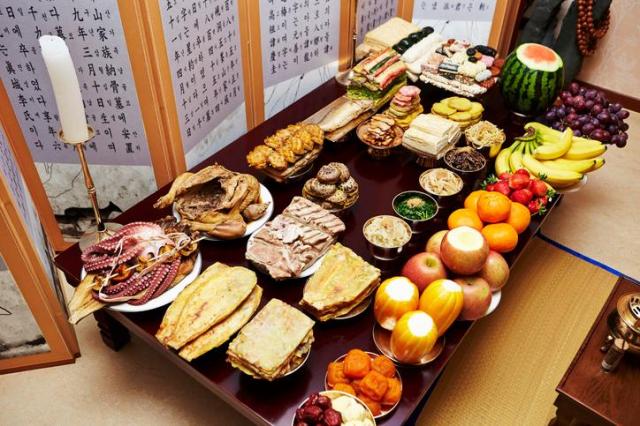
The ritual, known as "Charye," is a traditional Confucian memorial service held on the morning of the Lunar New Year. Families gather to set a table laden with specific offerings—including meats, fruits, vegetables, and rice cakes—to honor deceased ancestors and seek their blessing for the household's health and prosperity. While deeply rooted in Korean culture, the practice requires days of meticulous cooking and preparation, a responsibility that has traditionally fallen heavily on the women of the household.
Recognizing the growing fatigue with these demands, major establishments, including JW Marriott Dongdaemun Square, Fairmont Ambassador Seoul, and The Plaza, have rolled out "Charye To-Go" packages for the upcoming holiday. According to industry reports released Sunday, these sets range in price from approximately 200,000 won ($135) to 600,000 won and offer complete rite tables featuring dozens of required dishes such as "jeon" (pan-fried delicacies), "galbijjim" (braised short ribs), and dried fish, all prepared by professional chefs.
The trend has evolved beyond simple convenience to include "star power" marketing. This year, the influence of the hit Netflix cooking competition "Culinary Class Wars" has reached the ritual table, with Mayfield Hotel Seoul launching a premium "Sechan" set overseen by head chef Lee Keum-hee, a contestant from the show's second season. Retailers noted that while sales of these packages dipped slightly after the height of the COVID-19 pandemic, demand has stabilized and is now driven by a loyal customer base seeking to balance tradition with modern lifestyles.
This commercialization of the rite is a direct response to the growing economic and social burden of the tradition. Data from the Korea Agro-Fisheries & Food Trade Corporation indicates that South Korean families must spend an average of 380,000 won at supermarkets to prepare a single Charye table, a cost that continues to rise annually due to inflation. This combination of labor intensity and rising food prices has soured public sentiment toward the ritual, leading many to seek alternatives or abandon the practice altogether.
A survey conducted by Sungkyunkwan, the country's oldest Confucian institute, revealed that approximately 56 percent of South Koreans plan to stop holding memorial rites entirely. Respondents cited the "burden of food preparation" and the belief that the practice is "outdated" as primary reasons for opting out. For those unwilling to completely abandon their heritage, the hotel-made rite table has emerged as a compromise, allowing families to maintain the ceremonial form without the kitchen stress.
Park Sae-jin Reporter swatchsjp@ajunews.com
![[포토] 폭설에 밤 늦게까지 도로 마비](https://image.ajunews.com/content/image/2025/12/05/20251205000920610800.jpg)
![[포토] 국회 예결위 참석하는 김민석 총리](https://cphoto.asiae.co.kr/listimg_link.php?idx=2&no=2025110710410898931_1762479667.jpg)
![[포토] 알리익스프레스, 광군제 앞두고 팝업스토어 오픈](https://cphoto.asiae.co.kr/listimg_link.php?idx=2&no=2025110714160199219_1762492560.jpg)
![[포토] 예지원, 전통과 현대가 공존한 화보 공개](https://image.ajunews.com/content/image/2025/10/09/20251009182431778689.jpg)

![[포토]두산 안재석, 관중석 들썩이게 한 끝내기 2루타](https://file.sportsseoul.com/news/cms/2025/08/28/news-p.v1.20250828.1a1c4d0be7434f6b80434dced03368c0_P1.jpg)
![[작아진 호랑이③] 9위 추락 시 KBO 최초…승리의 여신 떠난 자리, KIA를 덮친 '우승 징크스'](http://www.sportsworldi.com/content/image/2025/09/04/20250904518238.jpg)
![[포토]첫 타석부터 안타 치는 LG 문성주](https://file.sportsseoul.com/news/cms/2025/09/02/news-p.v1.20250902.8962276ed11c468c90062ee85072fa38_P1.jpg)
![블랙핑크 제니, 매력이 넘쳐! [포토]](https://file.sportsseoul.com/news/cms/2025/09/05/news-p.v1.20250905.c5a971a36b494f9fb24aea8cccf6816f_P1.jpg)
![블랙핑크 제니, 최강매력! [포토]](https://file.sportsseoul.com/news/cms/2025/09/05/news-p.v1.20250905.ed1b2684d2d64e359332640e38dac841_P1.jpg)
![[포토] 박지현 '아름다운 미모'](http://www.segye.com/content/image/2025/11/19/20251119519369.jpg)
![[포토] 아홉 '신나는 컴백 무대'](http://www.segye.com/content/image/2025/11/04/20251104514134.jpg)
![[포토] 김고은 '단발 여신'](http://www.segye.com/content/image/2025/09/05/20250905507236.jpg)

![[포토] 박지현 '순백의 여신'](http://www.segye.com/content/image/2025/09/05/20250905507414.jpg)
![[포토] 키스오브라이프 하늘 '완벽한 미모'](http://www.segye.com/content/image/2025/09/05/20250905504457.jpg)
![[포토] 언론 현업단체, "시민피해구제 확대 찬성, 권력감시 약화 반대"](https://image.ajunews.com/content/image/2025/09/05/20250905123135571578.jpg)
![[포토] 발표하는 김정수 삼양식품 부회장](https://image.ajunews.com/content/image/2025/11/03/20251103114206916880.jpg)
![[포토] '삼양1963 런칭 쇼케이스'](https://image.ajunews.com/content/image/2025/11/03/20251103114008977281.jpg)
![[포토] 김고은 '상연 생각에 눈물이 흘러'](http://www.segye.com/content/image/2025/09/05/20250905507613.jpg)

![[포토]끝내기 안타의 기쁨을 만끽하는 두산 안재석](https://file.sportsseoul.com/news/cms/2025/08/28/news-p.v1.20250828.0df70b9fa54d4610990f1b34c08c6a63_P1.jpg)
![[포토] 한샘, '플래그십 부산센텀' 리뉴얼 오픈](https://image.ajunews.com/content/image/2025/10/31/20251031142544910604.jpg)
![[포토] 아이들 소연 '매력적인 눈빛'](http://www.segye.com/content/image/2025/09/12/20250912508492.jpg)
![[포토]두산 안재석, 연장 승부를 끝내는 2루타](https://file.sportsseoul.com/news/cms/2025/08/28/news-p.v1.20250828.b12bc405ed464d9db2c3d324c2491a1d_P1.jpg)
![[포토] 키스오브라이프 쥴리 '단발 여신'](http://www.segye.com/content/image/2025/09/05/20250905504358.jpg)