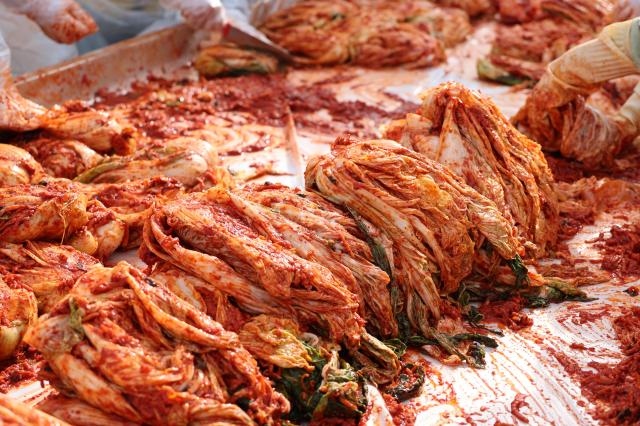
 Kimchi is seen during the Garak Kimjang Festival at Garak-dong in Seoul on Nov. 17, 2025. AJP Yoo Na-hyunSEOUL, January 14 (AJP) - Kimchi, South Korea's fermented staple, has been included in U.S. government dietary guidelines for its potential benefits to gut health. Yet a new Korean study suggests that high salt intake from kimchi and other traditional foods may contribute to cancer risk — challenging the widely held view that the Korean diet is inherently healthy.
 The study, led by researchers from Seoul National University and published in the government-funded journal Epidemiology and Health, estimates that 6.08 percent of cancer cases and 5.70 percent of cancer deaths in Korea are attributable to dietary factors. The findings, indexed in PubMed at the U.S. National Library of Medicine, raise fresh questions about the long-term health impact of salt-heavy eating patterns.
Using national health and nutrition survey data and large Korean cohort studies, the research team calculated population-attributable fractions (PAFs) for diet-related cancers between 2015 and 2030.
Korea's diet-attributable cancer incidence exceeds that of the United States (5.2 percent) and France (5.4 percent), though it remains lower than that of the United Kingdom (9.2 percent) and Germany (7.8 percent).
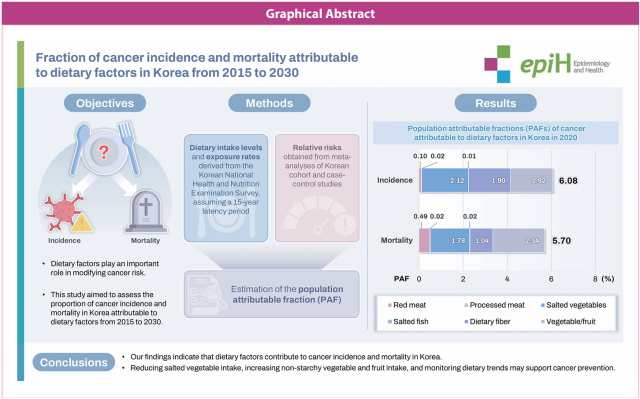 Courtesy of Epidemiology and HealthAmong dietary factors, salted vegetables — including kimchi, salted cabbage, radish and cucumber — emerged as the single largest contributor to cancer burden. In 2020, salted vegetables accounted for an estimated 2.12 percent of all cancer cases and 1.78 percent of cancer deaths, with a particularly strong association with stomach cancer.
 More than 44 percent of diet-related cancer cases were stomach cancers, which also made up over 37 percent of diet-related cancer deaths. The PAFs for diet-related stomach cancer reached 24.61 percent for incidence and 24.27 percent for mortality, suggesting that roughly one in four stomach cancer cases in Korea may be linked to dietary factors.
"The findings quantify how a salt-heavy diet structurally drives the burden of stomach cancer in Korea," the authors wrote.
The dietary impact was notably higher among men than women. For men, 8.43 percent of cancer cases and 7.93 percent of cancer deaths were linked to diet, compared with 3.45 percent and 2.08 percent, respectively, for women. The researchers attributed the gap to higher consumption of salted vegetables, red and processed meat, and lower intake of vegetables and fruit among men.
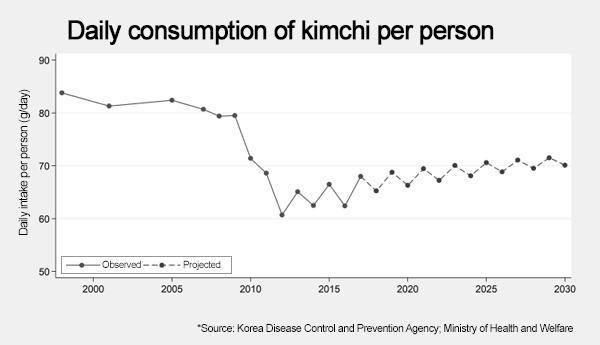
Salted vegetable consumption has been gradually declining, driven by sodium-reduction policies and changing eating habits. Even so, the study projects that salted vegetables will remain Korea's largest dietary cancer risk factor through 2030, underscoring the need to reduce both portion size and salt content.
The researchers also warned that cutting back on salty foods alone will have limited impact unless accompanied by broader dietary changes. Low intake of non-starchy vegetables and fruit was identified as another major driver of cancer risk.
Koreans consume an average of 340.5 grams of vegetables and fruit per day — well below the internationally recommended range of 490 to 730 grams. The shortfall increases the risk of stomach and colorectal cancers, as well as certain respiratory and digestive cancers. The cancer burden linked to insufficient produce intake is expected to remain largely unchanged through 2030.
Red and processed meat showed relatively low PAFs in Korea — accounting in 2020 for just 0.10 percent and 0.02 percent of cancer cases, respectively — largely because consumption remains lower than in many Western countries. However, the study warned that steadily rising intake since the mid-2000s could raise the PAF for processed meat to 0.08 percent by 2030, amplifying its impact over time.
"Diet-based cancer prevention in Korea must go beyond reducing salted vegetables," the authors wrote. "It is essential to increase the consumption of fresh vegetables, fruit and dietary fiber at the same time."
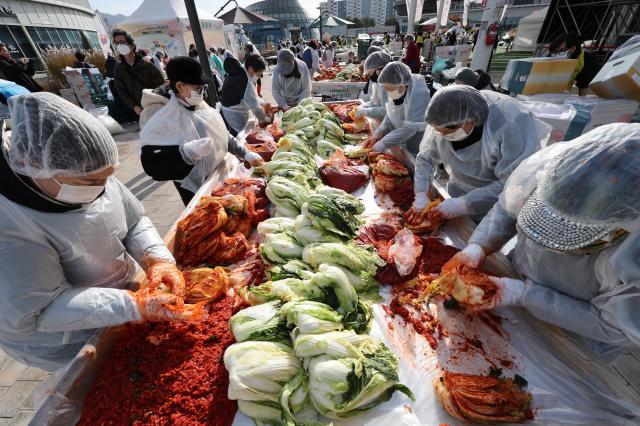 Volunteers make kimchi during the Garak Kimjang Festival in Seoul on Nov. 17, 2025. AJP Yoo Na-hyunFor Koreans, kimchi is more than a side dish. It anchors daily meals and symbolizes warmth and hospitality at the table. Sharing kimchi is often a way of sharing affection — whether passed to a neighbor or sent to family living far away.
 Each winter, families and communities gather for gimjang, the traditional kimchi-making season, salting and seasoning cabbage in large batches to last through the cold months. Even as Korean kimchi gains global popularity, domestic consumption has been gradually declining, reflecting rising incomes and the steady westernization of diets.
 Graphics by AJP Song Ji-yoon
 Kim Hee-su Reporter khs@ajupress.com

![[포토] 폭설에 밤 늦게까지 도로 마비](https://image.ajunews.com/content/image/2025/12/05/20251205000920610800.jpg)

![[포토] 국회 예결위 참석하는 김민석 총리](https://cphoto.asiae.co.kr/listimg_link.php?idx=2&no=2025110710410898931_1762479667.jpg)

![[포토] 예지원, 전통과 현대가 공존한 화보 공개](https://image.ajunews.com/content/image/2025/10/09/20251009182431778689.jpg)
![[포토] 알리익스프레스, 광군제 앞두고 팝업스토어 오픈](https://cphoto.asiae.co.kr/listimg_link.php?idx=2&no=2025110714160199219_1762492560.jpg)
![[포토]두산 안재석, 관중석 들썩이게 한 끝내기 2루타](https://file.sportsseoul.com/news/cms/2025/08/28/news-p.v1.20250828.1a1c4d0be7434f6b80434dced03368c0_P1.jpg)

![[작아진 호랑이③] 9위 추락 시 KBO 최초…승리의 여신 떠난 자리, KIA를 덮친 '우승 징크스'](http://www.sportsworldi.com/content/image/2025/09/04/20250904518238.jpg)
![블랙핑크 제니, 최강매력! [포토]](https://file.sportsseoul.com/news/cms/2025/09/05/news-p.v1.20250905.ed1b2684d2d64e359332640e38dac841_P1.jpg)
![[포토]첫 타석부터 안타 치는 LG 문성주](https://file.sportsseoul.com/news/cms/2025/09/02/news-p.v1.20250902.8962276ed11c468c90062ee85072fa38_P1.jpg)
![[포토] 아홉 '신나는 컴백 무대'](http://www.segye.com/content/image/2025/11/04/20251104514134.jpg)
![블랙핑크 제니, 매력이 넘쳐! [포토]](https://file.sportsseoul.com/news/cms/2025/09/05/news-p.v1.20250905.c5a971a36b494f9fb24aea8cccf6816f_P1.jpg)
![[포토] 박지현 '아름다운 미모'](http://www.segye.com/content/image/2025/11/19/20251119519369.jpg)
![[포토] 키스오브라이프 하늘 '완벽한 미모'](http://www.segye.com/content/image/2025/09/05/20250905504457.jpg)

![[포토] 박지현 '순백의 여신'](http://www.segye.com/content/image/2025/09/05/20250905507414.jpg)
![[포토] 김고은 '단발 여신'](http://www.segye.com/content/image/2025/09/05/20250905507236.jpg)
![[포토] 발표하는 김정수 삼양식품 부회장](https://image.ajunews.com/content/image/2025/11/03/20251103114206916880.jpg)
![[포토] 언론 현업단체, "시민피해구제 확대 찬성, 권력감시 약화 반대"](https://image.ajunews.com/content/image/2025/09/05/20250905123135571578.jpg)
![[포토] '삼양1963 런칭 쇼케이스'](https://image.ajunews.com/content/image/2025/11/03/20251103114008977281.jpg)
![[포토] 한샘, '플래그십 부산센텀' 리뉴얼 오픈](https://image.ajunews.com/content/image/2025/10/31/20251031142544910604.jpg)

![[포토]끝내기 안타의 기쁨을 만끽하는 두산 안재석](https://file.sportsseoul.com/news/cms/2025/08/28/news-p.v1.20250828.0df70b9fa54d4610990f1b34c08c6a63_P1.jpg)
![[포토] 김고은 '상연 생각에 눈물이 흘러'](http://www.segye.com/content/image/2025/09/05/20250905507613.jpg)
![[포토] 아이들 소연 '매력적인 눈빛'](http://www.segye.com/content/image/2025/09/12/20250912508492.jpg)
![[포토]두산 안재석, 연장 승부를 끝내는 2루타](https://file.sportsseoul.com/news/cms/2025/08/28/news-p.v1.20250828.b12bc405ed464d9db2c3d324c2491a1d_P1.jpg)
![[포토] 키스오브라이프 쥴리 '단발 여신'](http://www.segye.com/content/image/2025/09/05/20250905504358.jpg)