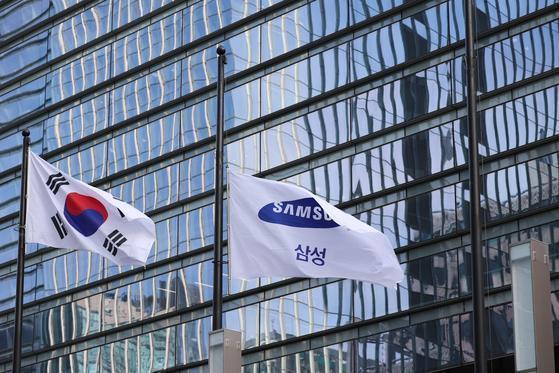
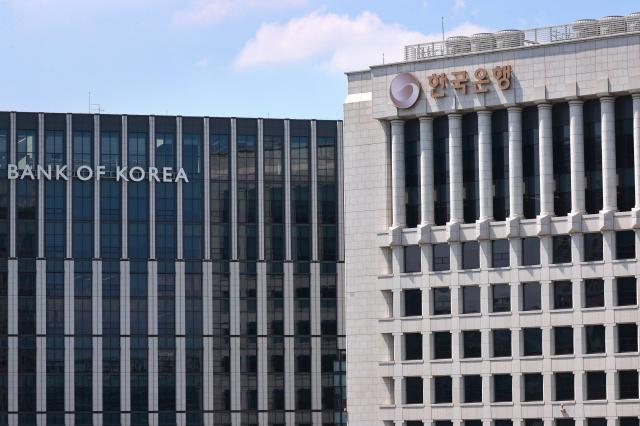
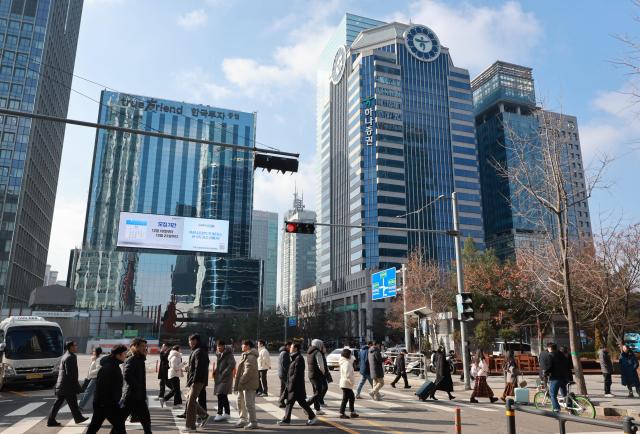
 This undated photo shows a view of Yeouido, the heart of Seoul’s financial district, where the headquarters of major brokerage firms and investment banks are concentrated. Yonhap.
 SEOUL, January 12 (AJP) - As an AI-driven frenzy continues to power record rallies in Seoul and on Wall Street, leveraged stock investment in South Korea has surged to historic highs, amplifying financial vulnerabilities in an economy where household debt already exceeds gross domestic product.
The benchmark KOSPI continued to rewrite records this week, climbing 0.84% to 4,624.79 - less than a week after breaking through 4,500. The index has rallied almost uninterrupted since mid-December, rising from below 4,000 on Dec. 18. The roughly 16 percent gain over that period extends a broader rally of about 75 percent since the start of 2025.
If last year’s rally was driven primarily by SK hynix, this year’s momentum has been led by Samsung Electronics. The stock has set successive record highs, briefly topping the 140,000-won level during morning trading.
The blistering equity surge — unfolding against a backdrop of sluggish economic indicators — is fueling concern rather than relief among policymakers and market watchers.
According to data from the Korea Financial Investment Association (KOFIA), margin trading balances reached a record 28 trillion won ($19.2 billion) as of Jan. 8, marking a more than 30 percent increase from a year earlier.
Margin debt, which allows investors to borrow against existing holdings to amplify returns, has accelerated sharply over the past three years. Growth stood near 10 percent in 2023, rose to about 20 percent in 2024 following the U.S. Federal Reserve’s aggressive rate cuts, and has surged further this year amid abundant global liquidity.
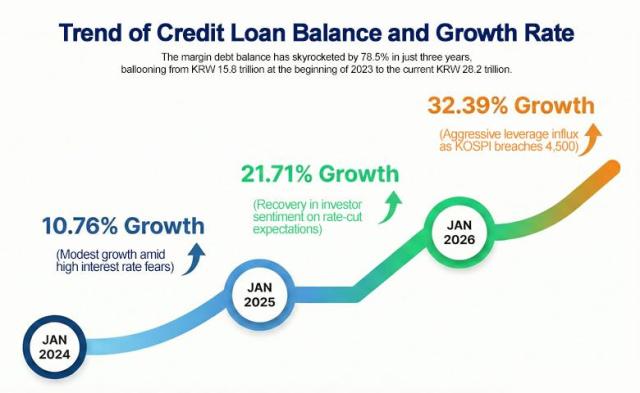 Graphics by AJP Song Ji-yoon.
 Risk appetite has been especially concentrated in blue-chip stocks. Samsung Electronics alone accounted for nearly 2 trillion won in margin debt as of early January. Analysts warn that such “borrowed-money” investment is highly vulnerable to external shocks — most notably a potential further rate hike by the Bank of Japan (BOJ).
BOJ Governor Kazuo Ueda signaled a continued hawkish stance at a New Year’s press conference on Jan. 5, indicating that the central bank would raise policy rates gradually from the current 0.75 percent as real interest rates remain deeply negative.
The BOJ’s policy meeting on Jan. 23, followed closely by the U.S. Federal Open Market Committee (FOMC) meeting, is expected to serve as a key test for the direction of the yen-carry trade. While Japan’s December rate hike was largely priced in, analysts caution that an additional move could push the yen beyond key psychological thresholds against the dollar.
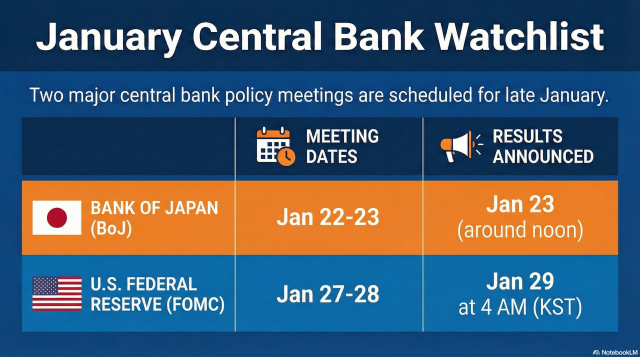 Generated with Notebook LM.
 “The ‘Black Monday’ crash in August 2024, when the Korean market plunged nearly 9 percent, was triggered the moment the yen hit 162 per dollar,” said Cho Yong-gu, a researcher at Shinyoung Securities. “Investors should closely monitor the yen-dollar exchange rate as the Fed weighs whether to hold or cut rates.”
Kwon Ah-min, a researcher at NH Investment & Securities, echoed the warning, noting that given the severe damage caused by the unwinding of yen-carry trades two years ago, market participants must watch closely where global capital flows once the yen begins to strengthen.
During the previous unwinding episode on Aug. 5, 2024, South Korean stocks suffered an 8.77 percent plunge, triggering widespread margin calls and heavy losses among retail investors. Samsung Electronics fell more than 10 percent, while SK hynix slid over 9 percent. With leverage now at even higher levels, a similar shock could pose systemic risks to the broader economy.
Rising debt yields are adding further strain to South Korea’s households, whose total debt surpassed a record 1,800 trillion won as of the third quarter last year. Data submitted by the Bank of Korea to the National Assembly show that average debt per borrower is approaching 100 million won, underscoring the fragility of private-sector balance sheets.
Global investment banks are also raising cautionary flags.
Goldman Sachs warned in a late-December report that a BOJ rate hike on Jan. 23 could become a “tipping point” for the yen-carry trade. Morgan Stanley said that if Japan’s real interest rates turn positive, a large-scale repatriation of capital to Japan could trigger a global market sell-off.
Identifying early warning signals will be critical in the current environment.
“When the yen strengthens by more than 1 percent in a single day, or when bond yields and credit default swap premiums spike beyond normal ranges, it should be seen as a sign that yen-carry unwinding has begun,” said Kim Young-ik, a former professor at Sogang University.
Kim Yeon-jae Reporter duswogmlwo77@ajupress.com

![[포토] 폭설에 밤 늦게까지 도로 마비](https://image.ajunews.com/content/image/2025/12/05/20251205000920610800.jpg)

![[포토] 국회 예결위 참석하는 김민석 총리](https://cphoto.asiae.co.kr/listimg_link.php?idx=2&no=2025110710410898931_1762479667.jpg)
![[포토] 알리익스프레스, 광군제 앞두고 팝업스토어 오픈](https://cphoto.asiae.co.kr/listimg_link.php?idx=2&no=2025110714160199219_1762492560.jpg)

![[포토] 예지원, 전통과 현대가 공존한 화보 공개](https://image.ajunews.com/content/image/2025/10/09/20251009182431778689.jpg)

![[포토]두산 안재석, 관중석 들썩이게 한 끝내기 2루타](https://file.sportsseoul.com/news/cms/2025/08/28/news-p.v1.20250828.1a1c4d0be7434f6b80434dced03368c0_P1.jpg)
![[작아진 호랑이③] 9위 추락 시 KBO 최초…승리의 여신 떠난 자리, KIA를 덮친 '우승 징크스'](http://www.sportsworldi.com/content/image/2025/09/04/20250904518238.jpg)
![블랙핑크 제니, 최강매력! [포토]](https://file.sportsseoul.com/news/cms/2025/09/05/news-p.v1.20250905.ed1b2684d2d64e359332640e38dac841_P1.jpg)
![[포토]첫 타석부터 안타 치는 LG 문성주](https://file.sportsseoul.com/news/cms/2025/09/02/news-p.v1.20250902.8962276ed11c468c90062ee85072fa38_P1.jpg)
![블랙핑크 제니, 매력이 넘쳐! [포토]](https://file.sportsseoul.com/news/cms/2025/09/05/news-p.v1.20250905.c5a971a36b494f9fb24aea8cccf6816f_P1.jpg)
![[포토] 키스오브라이프 하늘 '완벽한 미모'](http://www.segye.com/content/image/2025/09/05/20250905504457.jpg)
![[포토] 아홉 '신나는 컴백 무대'](http://www.segye.com/content/image/2025/11/04/20251104514134.jpg)
![[포토] 박지현 '아름다운 미모'](http://www.segye.com/content/image/2025/11/19/20251119519369.jpg)

![[포토] 박지현 '순백의 여신'](http://www.segye.com/content/image/2025/09/05/20250905507414.jpg)
![[포토] 김고은 '단발 여신'](http://www.segye.com/content/image/2025/09/05/20250905507236.jpg)
![[포토] 발표하는 김정수 삼양식품 부회장](https://image.ajunews.com/content/image/2025/11/03/20251103114206916880.jpg)
![[포토] '삼양1963 런칭 쇼케이스'](https://image.ajunews.com/content/image/2025/11/03/20251103114008977281.jpg)
![[포토] 언론 현업단체, "시민피해구제 확대 찬성, 권력감시 약화 반대"](https://image.ajunews.com/content/image/2025/09/05/20250905123135571578.jpg)
![[포토]끝내기 안타의 기쁨을 만끽하는 두산 안재석](https://file.sportsseoul.com/news/cms/2025/08/28/news-p.v1.20250828.0df70b9fa54d4610990f1b34c08c6a63_P1.jpg)
![[포토] 한샘, '플래그십 부산센텀' 리뉴얼 오픈](https://image.ajunews.com/content/image/2025/10/31/20251031142544910604.jpg)
![[포토] 김고은 '상연 생각에 눈물이 흘러'](http://www.segye.com/content/image/2025/09/05/20250905507613.jpg)

![[포토] 아이들 소연 '매력적인 눈빛'](http://www.segye.com/content/image/2025/09/12/20250912508492.jpg)
![[포토]두산 안재석, 연장 승부를 끝내는 2루타](https://file.sportsseoul.com/news/cms/2025/08/28/news-p.v1.20250828.b12bc405ed464d9db2c3d324c2491a1d_P1.jpg)
![[포토] 키스오브라이프 쥴리 '단발 여신'](http://www.segye.com/content/image/2025/09/05/20250905504358.jpg)