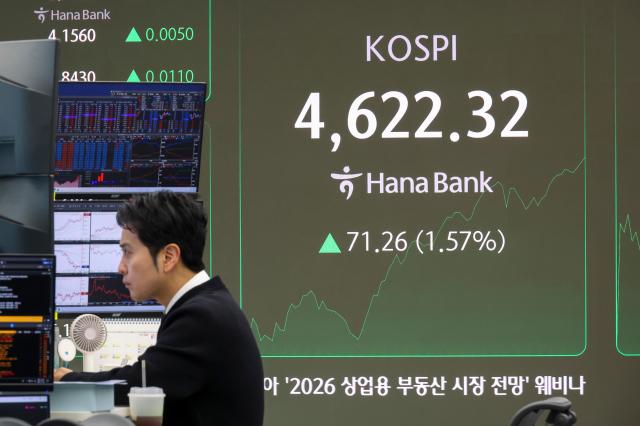
 A stock market board at a Hana Bank dealing room in Seoul displays stock indices and the exchange rate on January 8. The KOSPI, which hit an intraday high, pared its gains in the afternoon to close flat. AJP Yoo Na-hyun.
 SEOUL, January 08 (AJP) - Authorities have blamed overseas securities investment for the stubborn weakness of the Korean won and have rolled out incentives to encourage capital to return home. But for many individual investors, tax treatment remains a decisive reason to stick with foreign exchange-traded funds (ETFs).
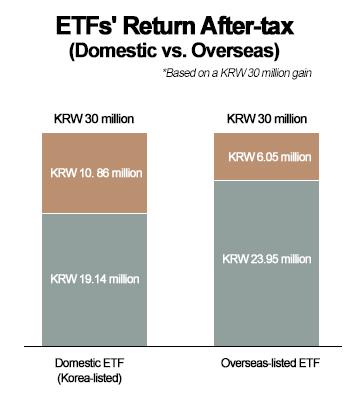
An investor who generates 30 million won ($20,691) in profits from Korea-listed ETFs within a pension account would take home about 19.1 million won after tax. That implies an effective tax rate of roughly 35 percent.
By contrast, profits from overseas-listed ETFs are subject to a flat 22 percent capital gains tax on excess earnings, allowing the same investor to retain around 24 million won. The arithmetic alone tilts preferences toward overseas ETFs.
 Graphics by AJP Song Ji-yoon
 How Korea’s ETF tax system works
South Korea’s ETF taxation rests on two pillars: dividend income tax and global income tax.
Investment profits of up to 20 million won are subject only to dividend income tax. Once gains exceed that threshold, the excess is classified as “other income” and added to earned income, triggering progressive global income tax rates.
For higher earners, this can push the marginal tax rate as high as 49.5 percent. As a result, a 30 million won gain can translate into a 35 percent tax burden, significantly eroding net returns.
A widening global gap
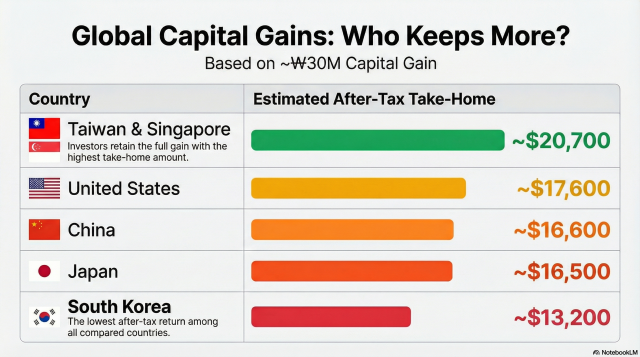
The disparity becomes more pronounced in international comparison. For the same 30 million won gain, investors in Japan or China would retain about 24 million won. In the United States, the most popular destination for Korean investors, long-term capital gains are taxed at 15 percent, leaving investors with more than 25 million won.
In Taiwan and Singapore, capital gains from ETFs are largely untaxed beyond transaction fees, allowing investors to keep nearly the full amount.
 Generated with Notebook LM
 Capital outflows accelerate
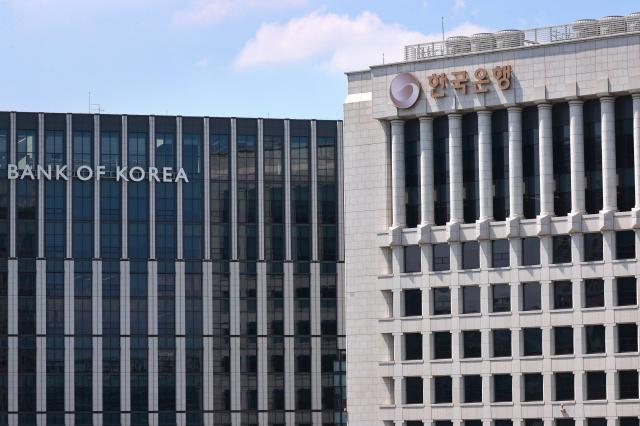
Against this backdrop, the shift toward foreign securities has intensified. According to a press release from the Bank of Korea last December, South Korean residents invested $99.85 billion in foreign stocks and bonds between January and September last year — more than three times the $29.65 billion foreign investors put into Korean securities over the same period.
The ETF market mirrors this trend. Based on data from ETFGI and the Korea Exchange, capital inflows from Korea into overseas ETFs reached an estimated 150–160 trillion won last year, more than double the 77.5 trillion won that flowed into domestically listed ETFs. While Korean ETFs still lead in total assets under management, the gap is narrowing rapidly.
“Too much capital from individual investors is flowing overseas,” BOK Governor Rhee Chang-yong said at a press conference following a Monetary Policy Board meeting in November, stressing the need to induce net inflows to help stabilize the exchange rate.
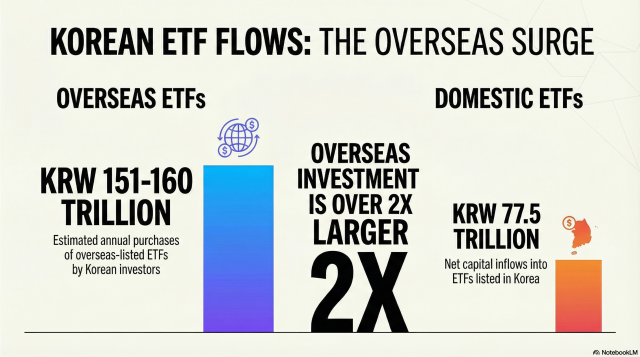 Generated with Notebook LM
 Policy friction, structural problem
In response, authorities began requiring investors in overseas-listed ETFs to complete a mandatory one-hour educational session starting last December — a move widely interpreted as an attempt to slow capital outflows by raising procedural hurdles.
Market participants argue, however, that such measures fail to address the root cause.
The Korea Capital Market Institute noted that disparities in ETF taxation and regulation have created structural incentives for high-net-worth investors to favor overseas products. The institute has called for tax neutrality between domestically listed overseas ETFs and overseas-listed ETFs.
“We are seeing a phenomenon where Koreans ‘direct-purchase’ Korean ETFs through foreign markets,” said Lim Tae-hyuk, head of ETF management at Samsung Securities. “Eliminating double taxation would bring domestic investors back to the home market.”
Kim Jung-hyun, head of ETF business at Shinhan Asset Management, echoed the view, calling for separate taxation of dividend income for domestic ETFs held in individual retirement pensions.
“For the long-term growth of Korea’s capital market,” he said, “structural tax reform is no longer optional.”
Kim Yeon-jae Reporter duswogmlwo77@ajupress.com
![[포토] 폭설에 밤 늦게까지 도로 마비](https://image.ajunews.com/content/image/2025/12/05/20251205000920610800.jpg)
![[포토] 예지원, 전통과 현대가 공존한 화보 공개](https://image.ajunews.com/content/image/2025/10/09/20251009182431778689.jpg)
![[포토]두산 안재석, 관중석 들썩이게 한 끝내기 2루타](https://file.sportsseoul.com/news/cms/2025/08/28/news-p.v1.20250828.1a1c4d0be7434f6b80434dced03368c0_P1.jpg)
![[작아진 호랑이③] 9위 추락 시 KBO 최초…승리의 여신 떠난 자리, KIA를 덮친 '우승 징크스'](http://www.sportsworldi.com/content/image/2025/09/04/20250904518238.jpg)
![블랙핑크 제니, 최강매력! [포토]](https://file.sportsseoul.com/news/cms/2025/09/05/news-p.v1.20250905.ed1b2684d2d64e359332640e38dac841_P1.jpg)
![블랙핑크 제니, 매력이 넘쳐! [포토]](https://file.sportsseoul.com/news/cms/2025/09/05/news-p.v1.20250905.c5a971a36b494f9fb24aea8cccf6816f_P1.jpg)
![[포토]첫 타석부터 안타 치는 LG 문성주](https://file.sportsseoul.com/news/cms/2025/09/02/news-p.v1.20250902.8962276ed11c468c90062ee85072fa38_P1.jpg)
![[포토] 국회 예결위 참석하는 김민석 총리](https://cphoto.asiae.co.kr/listimg_link.php?idx=2&no=2025110710410898931_1762479667.jpg)
![[포토] 김고은 '단발 여신'](http://www.segye.com/content/image/2025/09/05/20250905507236.jpg)
![[포토] 발표하는 김정수 삼양식품 부회장](https://image.ajunews.com/content/image/2025/11/03/20251103114206916880.jpg)
![[포토] 박지현 '아름다운 미모'](http://www.segye.com/content/image/2025/11/19/20251119519369.jpg)
![[포토] 키스오브라이프 하늘 '완벽한 미모'](http://www.segye.com/content/image/2025/09/05/20250905504457.jpg)
![[포토] 알리익스프레스, 광군제 앞두고 팝업스토어 오픈](https://cphoto.asiae.co.kr/listimg_link.php?idx=2&no=2025110714160199219_1762492560.jpg)
![[포토] '삼양1963 런칭 쇼케이스'](https://image.ajunews.com/content/image/2025/11/03/20251103114008977281.jpg)
![[포토] 박지현 '순백의 여신'](http://www.segye.com/content/image/2025/09/05/20250905507414.jpg)
![[포토] 언론 현업단체, "시민피해구제 확대 찬성, 권력감시 약화 반대"](https://image.ajunews.com/content/image/2025/09/05/20250905123135571578.jpg)
![[포토] 김고은 '상연 생각에 눈물이 흘러'](http://www.segye.com/content/image/2025/09/05/20250905507613.jpg)
![[포토] 아이들 소연 '매력적인 눈빛'](http://www.segye.com/content/image/2025/09/12/20250912508492.jpg)
![[포토]끝내기 안타의 기쁨을 만끽하는 두산 안재석](https://file.sportsseoul.com/news/cms/2025/08/28/news-p.v1.20250828.0df70b9fa54d4610990f1b34c08c6a63_P1.jpg)
![[포토] 한샘, '플래그십 부산센텀' 리뉴얼 오픈](https://image.ajunews.com/content/image/2025/10/31/20251031142544910604.jpg)
![[포토]두산 안재석, 연장 승부를 끝내는 2루타](https://file.sportsseoul.com/news/cms/2025/08/28/news-p.v1.20250828.b12bc405ed464d9db2c3d324c2491a1d_P1.jpg)
![[포토] 키스오브라이프 쥴리 '단발 여신'](http://www.segye.com/content/image/2025/09/05/20250905504358.jpg)
![[포토] 아홉 '신나는 컴백 무대'](http://www.segye.com/content/image/2025/11/04/20251104514134.jpg)