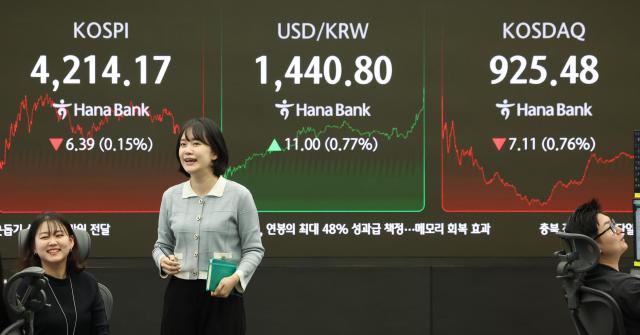
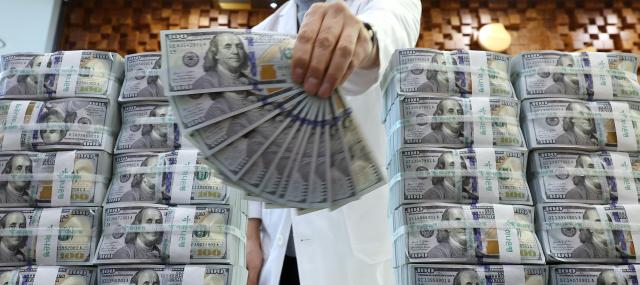
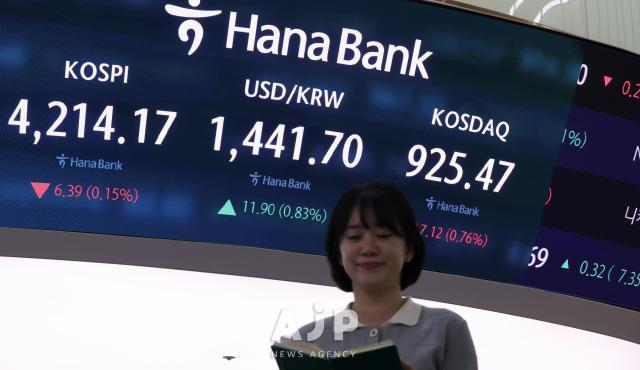
 Electronic boards at Hana Bank’s headquarters dealing room in central Seoul display the closing prices on the last trading day of South Korea’s stock market in 2025, Dec. 30. AJP Yoo Na-hyun
 SEOUL, December 31 (AJP) - Roaring stock prices and a tumbling currency defined South Korea’s financial markets in 2025 — a divergence that may persist well into next year.
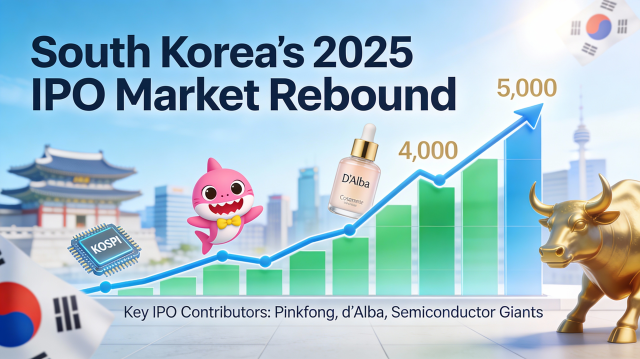
The benchmark KOSPI closed the year Tuesday at 4,214.17, up 75.6 percent from a year earlier, while the tech-heavy KOSDAQ jumped 37 percent to 925.47. Both far outperformed regional peers, powered by surging demand for semiconductors, shipbuilding and defense-related stocks.
Chipmakers were the undisputed champions. Samsung Electronics surged 125 percent to close at 119,900 won ($82.9), while SK hynix soared 250 percent to 651,000 won. Together, the two now account for more than one-third of the KOSPI’s total market capitalization, underscoring the market’s heavy concentration in artificial intelligence–linked plays.
Shipbuilders also enjoyed a banner year. Hanwha Ocean jumped 204 percent to 113,600 won, driven by its strategic alignment with U.S. industrial policy, including the acquisition of Philly Shipyard. The move has positioned the company to secure lucrative U.S. naval maintenance, repair and overhaul (MRO) contracts, alongside a strong backlog of LNG carrier orders.
Defense stocks delivered similarly robust gains. Hanwha Systems rose 140.7 percent, while LIG Nex1 climbed 90.9 percent, defying earlier expectations that easing tensions in the Middle East would dampen demand. Instead, the prolonged war in Ukraine and an intensifying global arms race continued to provide strong tailwinds.
“Semiconductor stocks are expected to account for more than half of the KOSPI’s projected 14 percent return in 2026,” said Lee Jae-man, a researcher at Hana Securities, adding that defense companies are also poised for further upside as the government earmarks a record share of its research and development budget for military technologies.
Lee singled out Hanwha Ocean for its strengthening pricing power and expanding profit margins.
Bullish outlook — with caveats
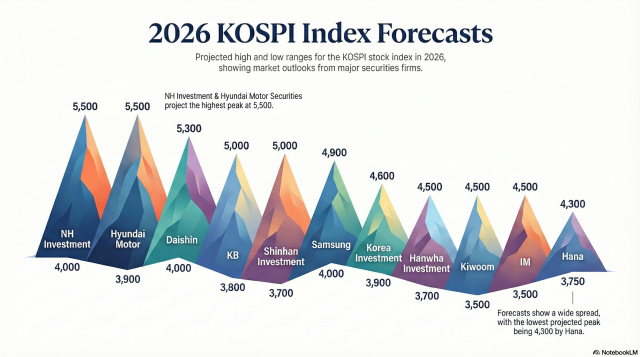 Generated with Notebook LM
 Market sentiment remains broadly optimistic. Daishin Securities and NH Investment & Securities project the KOSPI could peak between 5,300 and 5,500, supported by synchronized monetary easing and fiscal stimulus across major economies.
Lee Kyung-min, a strategist at Daishin, said the rally reflects a coordinated global shift toward rate cuts, suggesting the cyclical bull market could extend at least through the first half of 2026.
Government-led “value-up” initiatives have also helped narrow the so-called Korea discount. Measures such as tax incentives for higher dividend payouts, tighter fiduciary duties for corporate directors, and plans to expand pension fund investment into the KOSDAQ have bolstered investor confidence.
Still, risks are mounting. Analysts warn of renewed talk of an AI bubble and the possibility of a sharper-than-expected policy pivot if inflation reaccelerates.
“A liquidity squeeze following the end of the global easing cycle could trigger a market correction,” Hana Securities cautioned, noting that renewed inflation pressure in the United States could quickly sour risk sentiment.
Won weakness clouds the rally
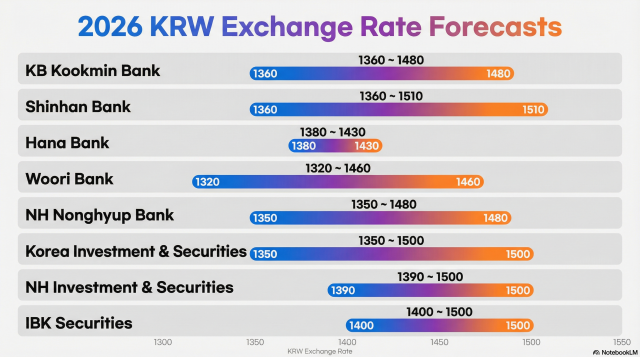 Generated with Notebook LM
 In stark contrast to soaring equities, the Korean won remained among the weakest major currencies. It closed the year at 1,445.4 per dollar, down nearly 9 percent from its high earlier in May.
The divergence between stocks and the currency is highly unusual.
“It is unprecedented for the KOSPI to break above 4,000 while the exchange rate stays entrenched above the 1,400-won level,” said Kim Hak-kyun, managing director at Shinyoung Securities.
A key driver has been the surge in overseas investment by Korean residents. From January to October, net outbound investment reached a record $117.1 billion, with $17.3 billion flowing out in October alone — the largest monthly outflow on record.
The wide interest-rate gap between South Korea and the United States continues to weigh on the won. While the Federal Reserve has begun easing, its policy rate of 3.75 percent still far exceeds the Bank of Korea’s 2.5 percent, limiting Seoul’s room to maneuver. The central bank remains constrained by household debt exceeding 1,000 trillion won, making rate hikes politically and economically untenable.
“Unless the U.S. economy deteriorates sharply, downward pressure on the won is likely to persist,” said Moon Jung-hee, an economist at KB Kookmin Bank.
Some relief may come from policy and structural developments. The government’s foreign-exchange stabilization measures and South Korea’s inclusion in the World Government Bond Index (WGBI) next April could provide a floor for the currency.
“The WGBI inclusion alone could attract stable long-term inflows, potentially pulling the exchange rate back toward the low-1,400 range,” said Seo Jeong-hoon, a researcher at Hana Bank. He added that a possible policy shift at the U.S. Federal Reserve under a Trump administration more inclined toward monetary easing could give the won additional breathing room by late 2026.
Kim Yeon-jae Reporter duswogmlwo77@ajupress.com
![[포토] 폭설에 밤 늦게까지 도로 마비](https://image.ajunews.com/content/image/2025/12/05/20251205000920610800.jpg)
![[포토] 예지원, 전통과 현대가 공존한 화보 공개](https://image.ajunews.com/content/image/2025/10/09/20251009182431778689.jpg)

![블랙핑크 제니, 매력이 넘쳐! [포토]](https://file.sportsseoul.com/news/cms/2025/09/05/news-p.v1.20250905.c5a971a36b494f9fb24aea8cccf6816f_P1.jpg)
![[포토]두산 안재석, 관중석 들썩이게 한 끝내기 2루타](https://file.sportsseoul.com/news/cms/2025/08/28/news-p.v1.20250828.1a1c4d0be7434f6b80434dced03368c0_P1.jpg)
![[작아진 호랑이③] 9위 추락 시 KBO 최초…승리의 여신 떠난 자리, KIA를 덮친 '우승 징크스'](http://www.sportsworldi.com/content/image/2025/09/04/20250904518238.jpg)
![블랙핑크 제니, 최강매력! [포토]](https://file.sportsseoul.com/news/cms/2025/09/05/news-p.v1.20250905.ed1b2684d2d64e359332640e38dac841_P1.jpg)
![[포토] 국회 예결위 참석하는 김민석 총리](https://cphoto.asiae.co.kr/listimg_link.php?idx=2&no=2025110710410898931_1762479667.jpg)
![[포토] 박지현 '아름다운 미모'](http://www.segye.com/content/image/2025/11/19/20251119519369.jpg)
![[포토] 키스오브라이프 하늘 '완벽한 미모'](http://www.segye.com/content/image/2025/09/05/20250905504457.jpg)
![[포토]첫 타석부터 안타 치는 LG 문성주](https://file.sportsseoul.com/news/cms/2025/09/02/news-p.v1.20250902.8962276ed11c468c90062ee85072fa38_P1.jpg)
![[포토] 김고은 '단발 여신'](http://www.segye.com/content/image/2025/09/05/20250905507236.jpg)

![[포토] 발표하는 김정수 삼양식품 부회장](https://image.ajunews.com/content/image/2025/11/03/20251103114206916880.jpg)
![[포토] 박지현 '순백의 여신'](http://www.segye.com/content/image/2025/09/05/20250905507414.jpg)
![[포토] '삼양1963 런칭 쇼케이스'](https://image.ajunews.com/content/image/2025/11/03/20251103114008977281.jpg)
![[포토] 알리익스프레스, 광군제 앞두고 팝업스토어 오픈](https://cphoto.asiae.co.kr/listimg_link.php?idx=2&no=2025110714160199219_1762492560.jpg)
![[포토] 아이들 소연 '매력적인 눈빛'](http://www.segye.com/content/image/2025/09/12/20250912508492.jpg)

![[포토] 한샘, '플래그십 부산센텀' 리뉴얼 오픈](https://image.ajunews.com/content/image/2025/10/31/20251031142544910604.jpg)
![[포토]끝내기 안타의 기쁨을 만끽하는 두산 안재석](https://file.sportsseoul.com/news/cms/2025/08/28/news-p.v1.20250828.0df70b9fa54d4610990f1b34c08c6a63_P1.jpg)
![[포토] 언론 현업단체, "시민피해구제 확대 찬성, 권력감시 약화 반대"](https://image.ajunews.com/content/image/2025/09/05/20250905123135571578.jpg)
![[포토]두산 안재석, 연장 승부를 끝내는 2루타](https://file.sportsseoul.com/news/cms/2025/08/28/news-p.v1.20250828.b12bc405ed464d9db2c3d324c2491a1d_P1.jpg)
![[포토] 김고은 '상연 생각에 눈물이 흘러'](http://www.segye.com/content/image/2025/09/05/20250905507613.jpg)
![[포토] 키스오브라이프 쥴리 '단발 여신'](http://www.segye.com/content/image/2025/09/05/20250905504358.jpg)
![[포토] 아홉 '신나는 컴백 무대'](http://www.segye.com/content/image/2025/11/04/20251104514134.jpg)